






What is Bracing?
Bracings are structural components or assemblies that are intended to prevent buckling or reduce the effective unsupported length of columns, truss chords, towers and other members or structures loaded in compression. In particular cases, the same bracing is also used to withstand externally applied loads.
An adequate brace system requires both strength (to provide the necessary stabilizing forces) and stiffness(to limit the deformation of the braced components or structures and to cause them to behave in an intentional manner).In so many situations, the stiffness and strength requirements are correspondent to each other i.e. Less stiffness allows for greater deformations, which in turn results in more force on the bracing.
Braced frames are a very ordinary form of construction, being simple to analyses and economical to construct. Economy results from, nominally pinned connections between beams and columns. Bracing, which resists lateral loads and provides stability, generally comes from diagonal steel members or, from a concrete ‘core’. In braced construction, beams and columns are designed under vertical load only, assuming the bracing system to take all lateral loads.
Use of Bracing
A braced frame is a structural system generally used in structures subject to lateral loads due to wind and earthquake. The members in a braced frame are generally made of structural steel, which can work adequately both in compression and tension.
Design of Bracing
Bracing and its proper design (including its strength and stiffness) in real structures are topics of major concern to structural designers and engineers since both bracing and its design are important to their own stability performance under working loading conditions, as well as the overall integrity of the structure under extreme loadings such as those caused by severe earthquakes and strong winds or lateral loads. It is a general practice to design framed structures with lateral bracings to protect them against excessive lateral sways and deflections, to avoid buckling and premature collapses. This is done to get safe and economical designs.
Advantages of Braced Building
- Due to bracing of the buildings, lateral storey displacement, storey drift as well as axial force and bending moment in columns can be reduced to a noticeable level.
- Reduction in lateral displacement is an uppermost advantage. Concentric ‘X’ bracing is more effective than Eccentric ‘V’ bracing.
- Braced frames resist the seismic forces and wind, much more than non-braced buildings.
- Steel bracing is economical, easy to erect, consumes less space and has flexibility to design for achieving the required strength and stiffness.
Types of Bracing
01. Single Diagonals
02. Cross Bracing
03. K-Bracing
04. V Bracing
05. Eccentric BracingA structural system consists of different members such as footing, braced and unbraced column, beam, slab etc.
Braced and unbraced columns are basically vertical members which go throughout the height of the structural system i.e. from foundation to terrace.
Also Read:
Things to Check before Concreting Column
What is a Column?
The column can be categorized on different basis depending on its cross-section, length, behaviour, cross bracing, longitudinal reinforcement etc.
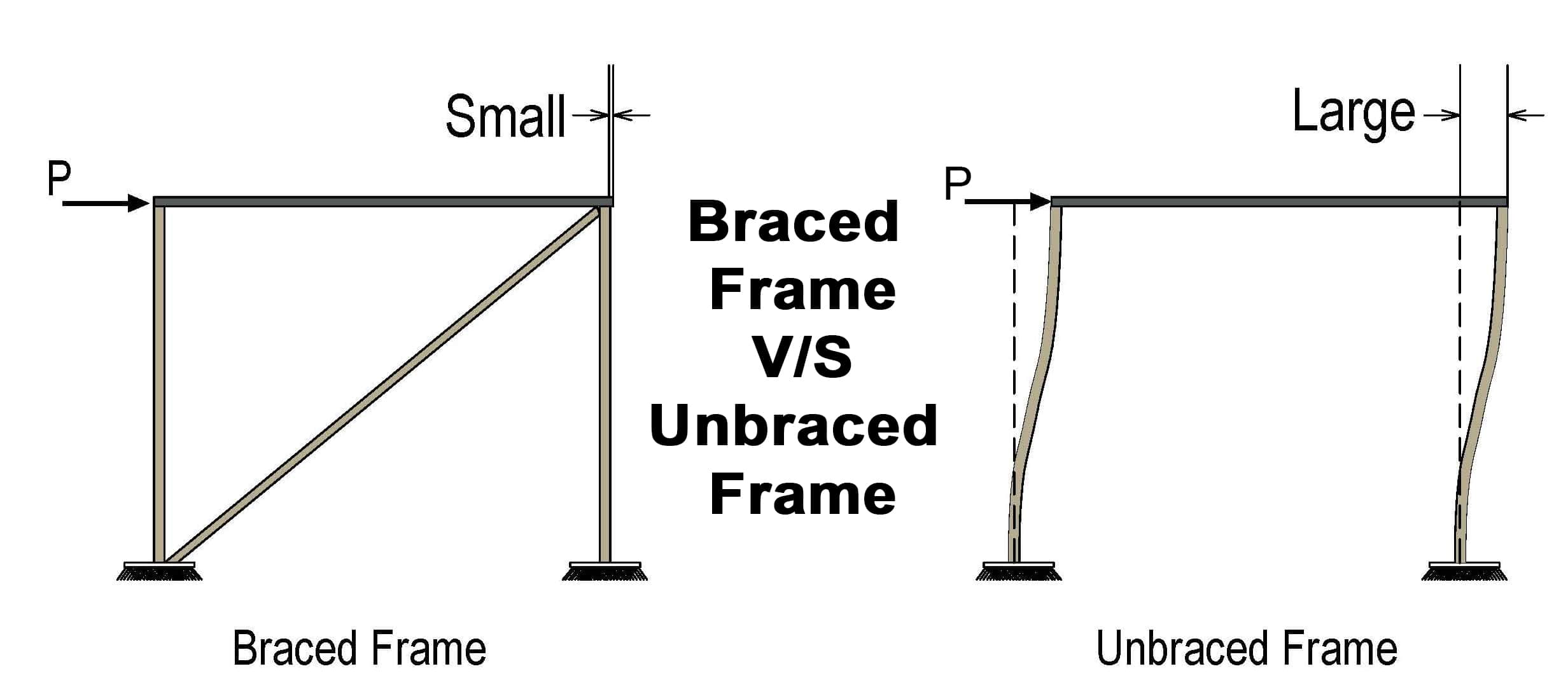
The resisting capacity of braced frame against sidesway is always remarkably larger than that of the unbraced frame. A braced building is the one which is reinforced by steel members which increase the compressive as well as tensile strength of the building.
Also Read:
What is the Difference Between Structural Analysis and Structural Design?
What is the Structural Analysis?
Difference Between Framed & Load Bearing Structure
Difference between Column & Shear Wall